As speculation grows over a possible US military confrontation with Iran, Israel’s leadership has adopted a notably restrained public posture.
Beyond limited expressions of support for recent anti-government protests in Iran, Prime Minister Benjamin Netanyahu and his government have largely avoided public comment on Washington’s military build-up in the Middle East — despite Iran being Israel’s foremost strategic adversary.
Analysts say the silence reflects both caution and calculation.
“It shows how significant this moment is for Netanyahu,” said Danny Citrinowicz, a former senior officer in Israel’s military intelligence who is now an Iran specialist at the Institute for National Security Studies. “With so many US forces positioned in the Gulf and President Trump seriously considering action against Iran, this is, from Netanyahu’s perspective, a rare opportunity.”
Israel’s quiet stance, according to former intelligence officials, is also intended to give Washington room to take the lead.

“The Israeli leadership believes this time the Americans should spearhead any action,” said Asaf Cohen, a former deputy head of Israel’s signals intelligence unit. “They have greater military capabilities and much broader international legitimacy.”
While Netanyahu has refrained from public pressure, contacts behind the scenes appear to be intensifying. Israel’s military intelligence chief, Major General Shlomi Binder, met US intelligence officials in Washington this week, with Israeli media reporting that potential targets inside Iran were discussed.
Citrinowicz believes Netanyahu is privately advocating for far-reaching strikes aimed at toppling Iran’s leadership. He argues that when Netanyahu reportedly urged Trump earlier this month to delay retaliation against Iran, it was not out of restraint, but concern that the proposed response was insufficient.
Netanyahu has previously encouraged Iranians to challenge their rulers, telling Fox News last year that they should “stand up” to the regime.
President Trump is weighing a range of options, from limited, symbolic military action to a campaign intended to bring about regime change. Publicly, he has alternated between issuing threats and offering renewed negotiations.
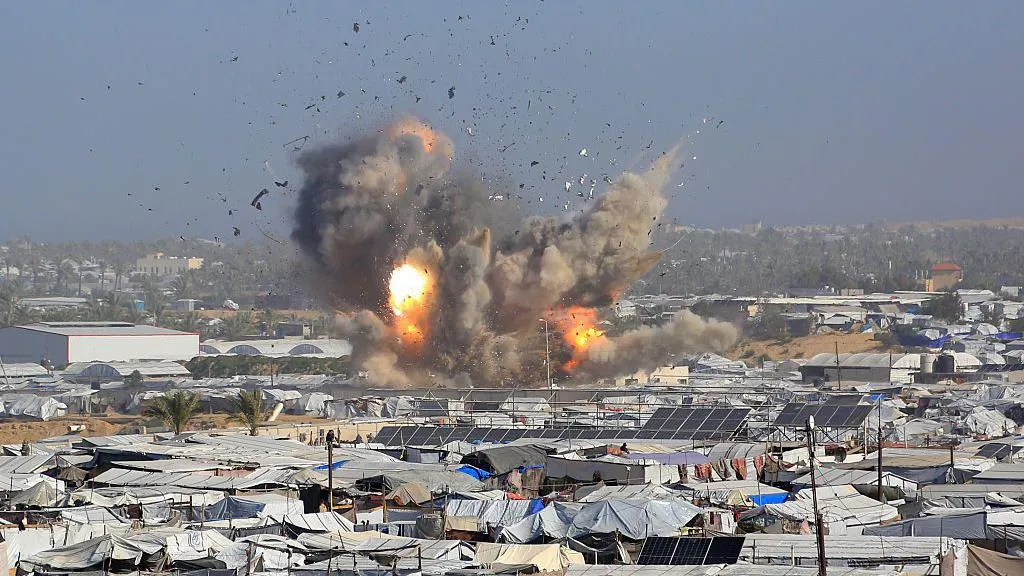
While many US allies warn that attempts to overthrow Iran’s leadership could plunge the region into deeper instability, the idea holds strong appeal in Israel’s security establishment.
Israeli officials argue that a new government in Tehran could eliminate the threat posed by Iran’s ballistic missile programme and remove the long-standing concern that Iran might eventually develop nuclear weapons. It could also weaken Iran’s regional network of armed allies, including Hezbollah, which Israeli researchers estimate still possesses tens of thousands of rockets in southern Lebanon.
By contrast, some Israeli politicians view limited strikes — or a return to diplomatic agreements — as more dangerous, fearing they would leave Iran’s current leadership intact and emboldened.
“When you face absolute evil, you cannot respond in half-measures,” said Moshe Tur-Paz, a member of the opposition Yesh Atid party and a parliamentarian on Israel’s Defence Committee. “There is broad agreement in Israel that Iran represents an existential threat, and that stronger action is needed.”
For many in Israel, another cycle of confrontation that fails to fundamentally weaken the Iranian regime would not justify the cost.
During last year’s 12-day conflict, Israel and the US struck Iranian nuclear and missile facilities, prompting Tehran to launch hundreds of ballistic missiles at Israeli cities. Several penetrated Israel’s air defence systems, hitting residential areas in Tel Aviv and killing at least 28 people.
To critics of limited military action, that episode underscored the risks of leaving Iran’s leadership in place — and reinforced the belief that only decisive change in Tehran can alter Israel’s security calculus.